ECO vs PMBOK, and how to study with this series
The PMP exam is written from the Examination Content Outline. The PMBOK Guide is a different document with a different job, and the two are not organised the same way. Here is how they fit together, where your 35 contact hours have to come from, and how to use this series.
Mr Oyelaran comes back from the garage with two things and sets them on the kitchen table.
The first is four sheets of paper, folded in half, run off on the club’s photocopier. It is a list of the situations the club is allowed to ask her about. Nothing on it tells her how to build anything.
The second is a ring binder thick enough to stand up on its own. That one is about building: how to work out what a build actually needs, how to tell whether a branch will hold weight, how to agree who is doing what before anyone picks up a saw.
Zara reaches for the binder, because it is bigger and looks more like proper homework.
He moves it out of reach and pushes the four sheets across instead.
Explain it like I’m 10
The folded sheets are the question list.
Here is the part that surprises people. Nobody wrote that list by reading the binder. The club went and watched people who really build things, asked them what they do all day, and wrote the list from the answers. So the list is a description of the job, and the binder is a description of how the job is done well. They overlap a lot. They are not the same thing, and they are not in the same order.
Which means two mistakes are available to Zara, and she will probably try both.
The first is to learn the binder’s order and expect the questions to arrive in it. The binder has a chapter about wobbly branches. She will study that chapter, feel ready for a question about wobbly branches, and then get asked about a neighbour complaining that the ladder blocks their path. That is a safety question about a branch, filed somewhere she never looked.
The second mistake is thinking the binder is the club. Reading about building on her own is how she learns. It is not how she becomes a member, and it is not what Mr Oyelaran will sign off on. The Saturdays are the Saturdays. You have to turn up to them.
The grown-up version
Two documents, two jobs
The Examination Content Outline is the list of what the exam can ask you. PMI built it from a job task analysis, had Alpine Testing Solutions turn that into the outline, and writes every exam item against it. Three domains, 26 tasks. If something is not traceable to a task on that outline, it cannot be on your exam.
The PMBOK Guide 8th edition is the reference for how project work is done. PMI published it digitally in November 2025 and in print in January 2026, and it is a larger departure from the 7th edition than most editions are from the one before. Principles dropped from twelve to six. Performance domains dropped from eight to seven. Process guidance came back, after the 7th edition removed it, as 40 non-prescriptive processes grouped into five focus areas.
| Examination Content Outline | PMBOK Guide 8th edition | |
|---|---|---|
| What it is for | what the exam can ask you | how the work is done |
| Current version | effective 9 July 2026 | November 2025 digital, January 2026 print |
| How it is organised | 3 domains, 26 tasks | 6 principles, 7 performance domains, 5 focus areas holding 40 processes |
| Standing with the exam | every item is written against it | one of several references behind it |
That last row is the one to sit with. The outline draws on more than the PMBOK Guide, so reading the Guide cover to cover is not the same as covering the exam. The Guide is the best single explanation of the material. The outline is the scope.
Where the two structures disagree
The seven performance domains in PMBOK 8 are subject areas: Governance, Scope, Schedule, Finance, Stakeholders, Resources, Risk. The three ECO domains are about what you do and who you do it with: People, Process, Business Environment. Those are two different ways of cutting the same material, so a chapter of the book does not land in one place on the outline.
Governance makes the point on its own. It is a performance domain in the book, with its own chapter. On the July 2026 outline it is not a domain at all. It sits inside Business Environment, next to compliance, managing and controlling changes, removing impediments and managing issues, continuous improvement, supporting organisational change, and evaluating changes in the external business environment.
Risk is the same story. Its own domain in the book, part of Business Environment on the outline. If you came up through the 6th edition you almost certainly filed risk and change control under process work, and on this outline they are business environment questions. That single reshuffle is most of why Business Environment went from 8% to 26%.
Procurement runs the other way. PMBOK 8 expands its coverage, and on the outline it is one task inside Process. Worth knowing before you spend three weeks on it.
So study from the book, and keep the outline open next to it. When you finish a chapter, find the tasks it serves and write them down. The chapter tells you how the work is done. The task tells you how it will be asked.
Where your 35 contact hours come from
This one is worth being blunt about, because it is the part of PMP eligibility people most often get wrong, and getting it wrong late is expensive.
PMI requires 35 hours of project management training before you can sit the exam. What counts is broader than most people assume. PMI Authorized Training Partners, China REPs, GAC-accredited programmes, courses from accredited higher education institutions, employer-sponsored programmes, training companies and consultants, and self-paced on-demand courses that include an end-of-course assessment.
What does not count is reading. Books on their own do not count, and neither do practice banks or this series. There is no mechanism by which a blog becomes contact hours, and anyone telling you otherwise is selling something. You need a course from one of the categories above, and PMI reserves the right to disqualify training it judges to be poor quality, so pick a provider that can state its category plainly.
The exception is the CAPM. If you hold an active CAPM certification, the 35 hours are waived outright.
Write your hours down as you go, with provider, dates, and hours. PMI says it is adding enhanced verification to the application system, and the version of you sitting an audit in eighteen months will be glad of a list.
How to use this series
Each post has the same two layers. A treehouse story to build the intuition, then the grown-up version with the exam vocabulary and where it sits on the outline. The story is doing real work, so do not skip it to get to the terms. Situational questions are won by people who understand what is happening in a scenario, and that is what the story installs.
A study loop that works, if you want one:
- Download the Examination Content Outline from PMI. It is free, and it is the only authoritative scope you will get. Print the 26 tasks.
- Read the post. Story first, then the grown-up version.
- Tick off the tasks that post covered on your printed list.
- Do the three practice questions without looking, then read the explanations even for the ones you got right. The explanation is where the reasoning lives.
- When the gaps show up on your task list, go to PMBOK 8 for the long version.
Two things this series is deliberately not. It is not contact hours, as above. And it is not a question bank. Three questions a post is enough to test whether an idea landed, and nowhere near enough practice volume for exam readiness. Budget for a proper simulator in the last few weeks.
The posts come out when I have time to write them properly rather than on a fixed day, and they are meant to be read in order, because later ones assume the earlier ones.
Exam trap
Tempting: PMBOK 8 has a Risk performance domain of its own, so risk questions on the exam are Process questions about technical delivery.
Why PMI rejects it: the book’s structure and the outline’s structure are not the same structure. On the July 2026 outline, risk sits inside Business Environment along with governance, compliance, and change control. A scenario about an unmitigated risk reaching a steering committee is a Business Environment question, and if you have been studying the domain as 8% of the exam because that is what it used to be, you have under-prepared a quarter of it.
Both documents on one page
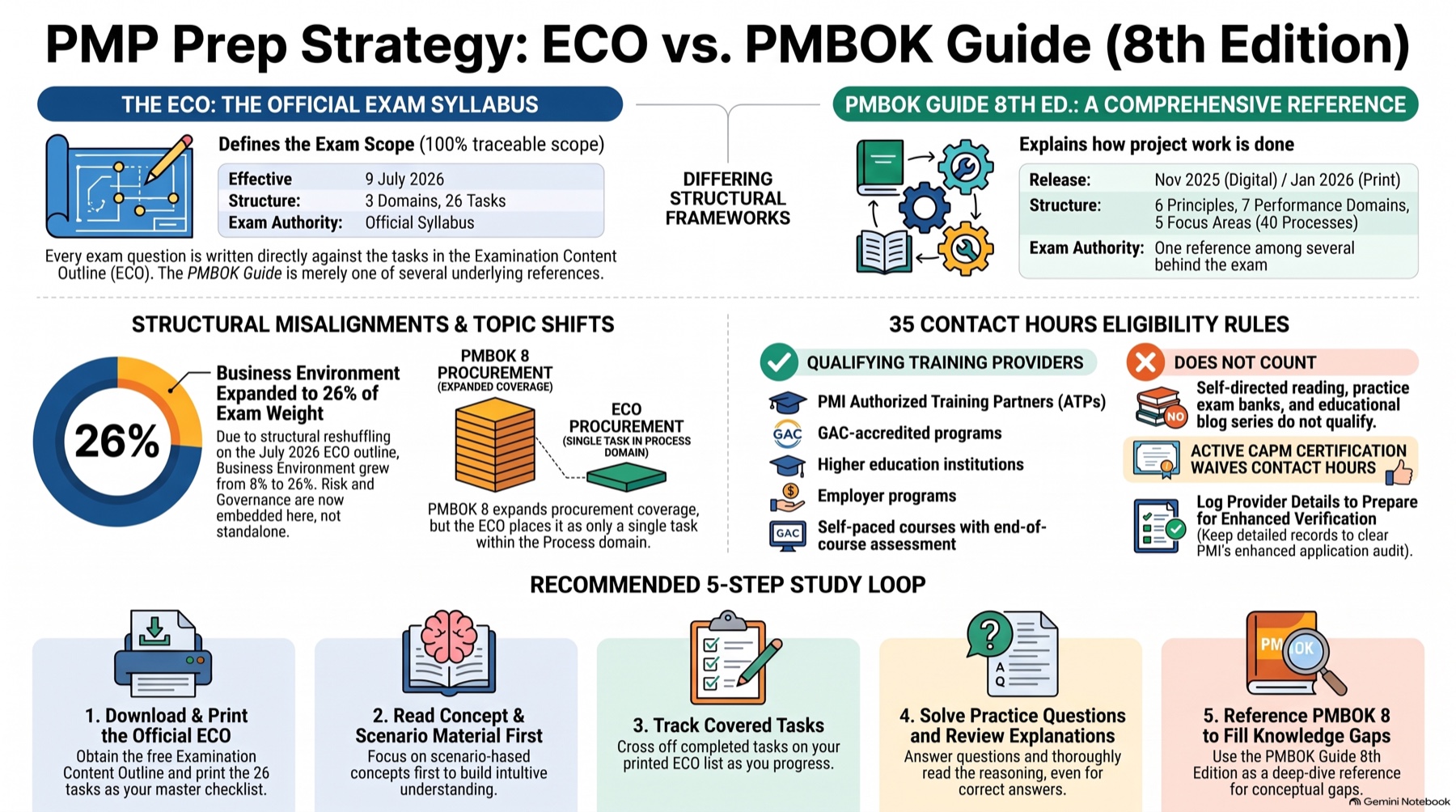 The two documents side by side, the places their structures pull apart, and the study loop at the bottom. Generated with Google NotebookLM from the text of this post.
Key points
- The exam is written from the Examination Content Outline. The PMBOK Guide is one of several references behind that outline, so finishing the Guide is not the same as covering the exam.
- The outline has 3 domains and 26 tasks. PMBOK 8 has 6 principles, 7 performance domains, and 40 processes across 5 focus areas. Neither structure maps cleanly onto the other.
- Governance and risk are performance domains in the book and parts of Business Environment on the outline. Procurement is expanded in the book and is one Process task on the outline.
- Study from the book, tick off tasks on the outline. The book tells you how the work is done, the task tells you how it gets asked.
- The 35 contact hours have to come from a qualifying provider. Books, question banks, and this series do not count. An active CAPM waives them.
- Keep a written record of your training hours, since PMI is adding further verification to the application process.
Student notes
A printable study sheet for this episode, with the two structures side by side and the contact hours rules on one page, is being put together. Email [email protected] and I will send it across when it is ready, along with the sheets for the other episodes as they are written.
Practice questions
1. A candidate has read PMBOK 8 cover to cover and organised all of their notes under the seven performance domains. In a mock exam they are repeatedly caught out by scenarios about escalating risks and approving changes, which they had filed as technical delivery topics. What is the most likely cause?
- A. The mock exam is based on the previous Examination Content Outline.
- B. The exam is written from the outline, where that material sits in Business Environment rather than in a risk domain of its own.
- C. PMBOK 8 does not cover risk, so their notes have a gap.
- D. Risk questions are drawn from a separate PMI standard and cannot be prepared for.
Answer
**B.** The seven performance domains are the book's structure, not the exam's. The July 2026 outline puts risk, change control, governance, compliance, and issue management inside Business Environment, which is 26% of the exam. Notes organised only by the book's chapters leave the candidate looking for this material in the wrong place. C is wrong because PMBOK 8 has a Risk performance domain. D invents a restriction that does not exist.2. You left school after upper-secondary education, have led projects for 62 non-overlapping months in the past six years, and have worked through every post in this series along with two PMP books and a 1,500-question practice bank. You have not taken a course. Are you eligible to apply?
- A. Yes. 62 months clears the requirement and your reading covers the training.
- B. Yes, provided you declare the books and the practice bank as self-paced training.
- C. No. The experience qualifies, but the 35 contact hours still have to come from a qualifying provider.
- D. No. The upper-secondary route needs 60 months of experience within the last five years.
Answer
**C.** The upper-secondary route needs 60 months of non-overlapping experience within the last ten years, and 62 months over six years satisfies both. Reading is not training. Self-paced on-demand courses can count, but only ones that include an end-of-course assessment, which rules out B. D misstates the window, which is ten years rather than five.3. A colleague studying for the same exam asks which document they should treat as the syllabus. Which answer is correct?
- A. PMBOK 8, because PMI publishes it and it contains the 40 processes.
- B. The Examination Content Outline, because every exam item is written against its tasks.
- C. Both equally, since PMI publishes both.
- D. Neither. PMI does not publish the scope of the exam.
Answer
**B.** The outline is the scope, and it is a free download. PMBOK 8 is the best single explanation of the material and one of several references behind the outline, which makes it the study text rather than the syllabus. A reverses the two. D is wrong because the outline is published specifically so candidates know what can be asked.The 90-second version
Use the ECO instead of PMBOK. About 90 seconds.
An Audio Overview generated with Google NotebookLM from the text of this post. The voices are synthetic.
Next episode
Everything above assumes you already know what a project is, which is the sort of assumption that costs marks. The outline expects you to tell a project apart from ongoing operations, and to know where programmes, portfolios, and the value delivery system sit around it. Next in the series: what a project actually is, and why the boundary matters more on the exam than it does in most jobs.
PMP, PMBOK, and PMI are registered marks of the Project Management Institute, Inc. This blog is independent and is not affiliated with, endorsed by, or sponsored by PMI. Content is for study support only and does not count toward the 35 contact hours required for PMP eligibility. Always refer to PMI’s official Examination Content Outline and PMP Handbook.