What the PMP is, and what changed in 2026
PMI rewrote the PMP exam content outline in July 2026. Business Environment went from 8% to 26%, the task list shrank, and the eligibility routes doubled. Here is what the badge is and what actually moved, explained first to a ten-year-old and then to you.
Zara is nine and has wanted a treehouse since the spring. The oak at the end of the garden has a fork in it about three metres up that looks, to her, exactly like a floor waiting for walls.
Her dad’s position is that the saw stays in the shed. He wants the treehouse too. What he won’t do is hand a saw to someone who hasn’t shown she knows how to use one.
Next door, Mr Oyelaran runs a Saturday build club out of his garage, and there’s a small enamel badge on the lid of his toolbox. Zara asked about it once and got a longer answer than she expected. Someone had checked his work across years of builds, and then sat him down and asked what he would do in situations he hadn’t been in yet.
So Zara asks for the rulebook. Mr Oyelaran goes to find it, then stops, because the copy in his drawer is out of date. The club rewrote it in July. Treehouses aren’t built the way they were when he got his badge.
Explain it like I’m 10
The PMP is the enamel badge.
The badge says two things about you. Someone checked that you have really led builds, with dates and hours written down. And someone checked that you know what to do when a build goes sideways, by asking you about situations instead of asking you to recite the rules.
The rulebook is the list of things they are allowed to ask you about. Change the rulebook and the questions change, even though the badge keeps the same name.
That is what happened this July.
The grown-up version
What the badge is
The Project Management Professional certification is run by the Project Management Institute, and it is accredited against ISO/IEC 17024, the standard for bodies that certify people. That accreditation is the reason the exam is shaped the way it is. PMI ran a job task analysis of what project managers actually do, had Alpine Testing Solutions build the Examination Content Outline from it, and writes every question against that outline.
Two gates stand between you and the badge. An application, where PMI checks your education, your experience leading projects, and 35 hours of training. Then a 180-question exam.
What moved in July 2026
PMI published a new Examination Content Outline and the updated exam went live on 9 July 2026.
| Previous ECO | July 2026 ECO | |
|---|---|---|
| People | 42% | 33% |
| Process | 50% | 41% |
| Business Environment | 8% | 26% |
| Tasks across the three domains | 35 | 26 |
| Questions | 180 | 180 |
| Exam time | 230 minutes | 240 minutes |
| Unscored pretest questions | 5 | 10 |
Business Environment went from the domain you could nearly ignore to roughly a quarter of the exam. Open the outline and the jump makes sense. Domain III now holds governance, compliance, managing and controlling changes, removing impediments and managing issues, risk, continuous improvement, supporting organisational change, and evaluating changes in the external business environment.
Risk, change control, and issue management are all in there, and most people who studied the old outline filed those under process work. On this outline they are business environment questions, and together with governance and compliance they are what tripled the domain.
The task list going from 35 to 26 pulls in the same direction. Fewer tasks across the same 180 questions means each task carries more weight and shows up more often. There is less room to gamble that a topic won’t come up.
The outline’s introduction also explains where artificial intelligence and sustainability fit. PMI fed both in as emerging trends during the job task analysis, then validated whether they correlated with the tasks project managers perform. The result is that neither gets a task of its own. Go through all 26 and you will not find one called AI. They are threaded into the tasks instead, which is a harder thing to study for and, I think, the more honest design.
The approach mix
The outline is unusually direct about this. Roughly 40% of items represent predictive approaches, and the remaining 60% is divided between adaptive, agile, and hybrid. It then says that approaches appear throughout all three domains and are not isolated to any particular domain or task.
That second sentence is the one to remember. The domain tells you what a question is about. It tells you nothing about which delivery approach the scenario is running.
Who can sit it now
The old two routes have become four.
| Education | Non-overlapping experience leading projects |
|---|---|
| Upper-secondary school, mapped to EQF 4 / ISCED 3 to 4 | 60 months |
| Associate’s level, higher certificate, or advanced vocational, mapped to EQF 5 / ISCED 5 | 48 months |
| Bachelor’s degree or higher, mapped to EQF 6 / ISCED 6 | 36 months |
| Bachelor’s or postgraduate degree from a GAC-accredited programme | 24 months |
All of it has to fall inside the last ten years, and non-overlapping is doing real work in that sentence. Two months spent leading two projects at once counts as two months, not four.
The two new rungs are the interesting part. A recognised vocational or associate-level qualification now gets you to 48 months, and a degree from a programme accredited by PMI’s Global Accreditation Center gets you to 24. The catch is the mapping. PMI wants your qualification mapped to a framework level, and if your certificate doesn’t cite one and your application is audited, you have to produce a national qualifications register entry, a statement from the awarding body, or a formal evaluation by a recognised national body. A title containing the word “advanced” or “professional” is not enough on its own.
The 35 hours of training survives, and what counts is broader than most people assume: PMI Authorized Training Partners, China REPs, GAC programmes, courses from accredited higher education institutions, employer-sponsored programmes, training companies and consultants, and self-paced on-demand courses that include an end-of-course assessment. Books and practice exams on their own do not count. PMI also reserves the right to disqualify training it judges to be poor quality, and says it is adding enhanced verification to the application system.
If you hold an active CAPM, the 35 hours are waived.
What exam day looks like
180 questions in 240 minutes. 170 of them are scored. The other 10 are pretest questions placed at random, which do not affect your result and are PMI trying out next year’s questions on you.
There are two 10-minute breaks, and where they fall tells you how the exam is built. The first comes after the case study section. The second comes roughly midway through the independent questions. Once you have reviewed your answers and started a break, you cannot go back to the previous section.
The question types are multiple choice with single or multiple correct responses, drag and drop, and what the outline calls practicum hands-on testing, which may include tools, data, and case study questions. The case study section is the piece I would sit with longest. A case set hangs several questions off one situation, so misreading the scenario doesn’t cost you one mark, it costs you the set.
Exam trap
Tempting: Process is still the biggest domain at 41%, so the exam is still mostly waterfall.
Why PMI rejects it: the outline puts 60% of items with adaptive, agile, and hybrid approaches, and states that approaches are not isolated to any particular domain or task. A Process question about schedule can just as easily describe a team pulling work off a board as a critical path through a network diagram. Mapping domains onto delivery approaches is the single most expensive assumption you can carry into this exam.
The whole update on one page
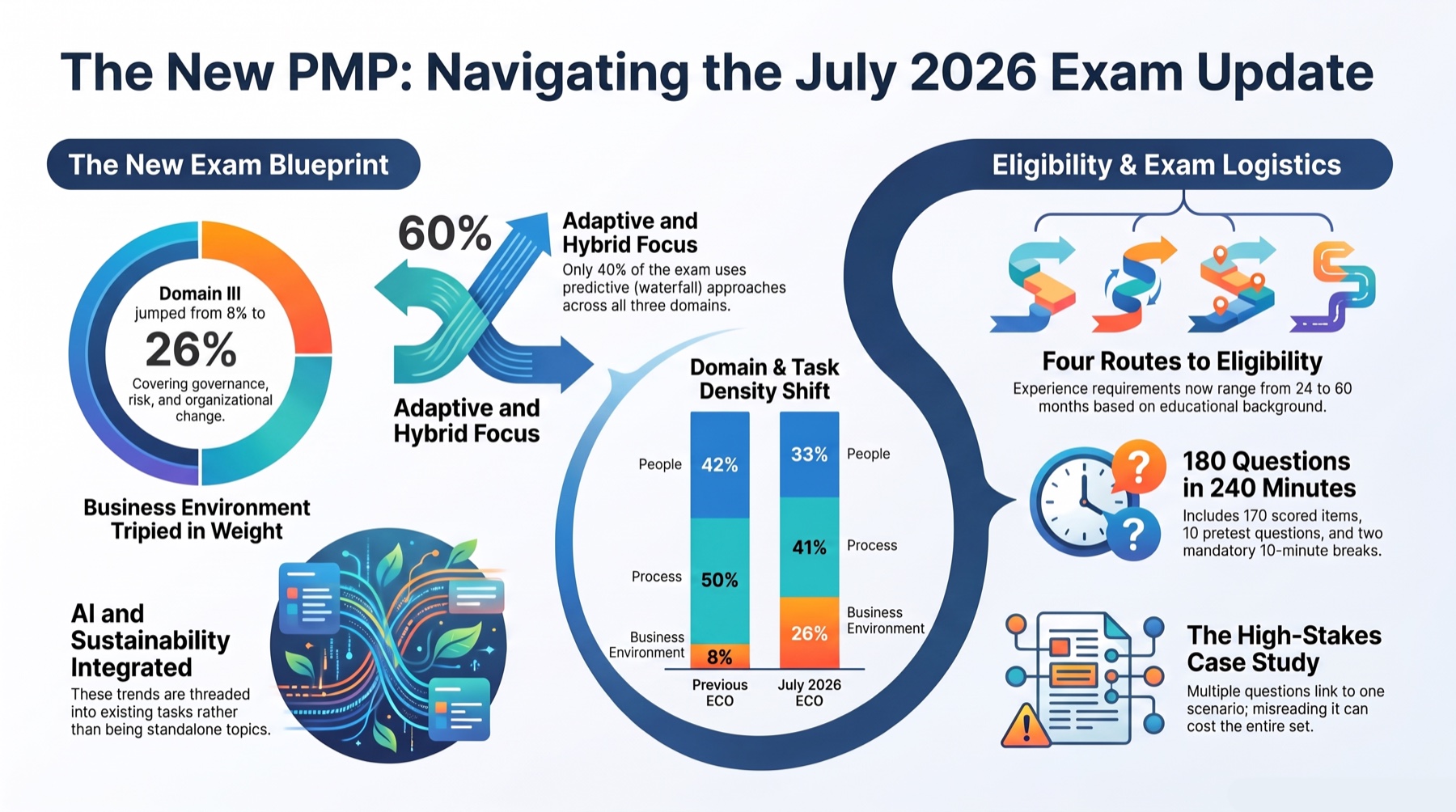 Everything above, on one page. If you are building a study plan, this is the sheet to keep next to it.
Key points
- The PMP is run by PMI and accredited against ISO/IEC 17024. The exam is written from the Examination Content Outline, not from the PMBOK Guide.
- A new ECO took effect on 9 July 2026. People 33%, Process 41%, Business Environment 26%.
- Business Environment tripled because governance, compliance, change control, issues, and risk now sit inside it.
- The task list shrank from 35 to 26, so every remaining task shows up more often.
- Roughly 40% of items are predictive and 60% are adaptive, agile, or hybrid, spread across all three domains.
- AI and sustainability have no task of their own. They are woven through the existing 26.
- There are now four eligibility routes needing 60, 48, 36, or 24 months of non-overlapping experience, all within the last ten years. An active CAPM waives the 35 training hours.
- 180 questions, 240 minutes, two 10-minute breaks, and a case study section you cannot return to once you have moved past it.
Practice questions
1. A colleague who passed in 2024 tells you the exam is about half predictive and half agile, and that Business Environment is barely worth studying. Which statement best describes the July 2026 exam?
- A. Predictive is about 50% of items and Business Environment is 8%.
- B. Predictive is about 40% of items and Business Environment is 26%.
- C. Predictive is about 60% of items and Business Environment is 26%.
- D. Each of the three domains carries roughly 33% of items.
Answer
**B.** Your colleague is describing the previous outline accurately. Under the July 2026 ECO, predictive drops to roughly 40% of items with the remaining 60% split between adaptive, agile, and hybrid, and Business Environment rises from 8% to 26%. C inverts the approach split. D describes nothing PMI has published.2. You hold a bachelor’s degree, have led projects for 30 months over the past four years, and hold an active CAPM certification. What still stands between you and exam eligibility?
- A. The 35 hours of commercial training.
- B. Six more months of experience leading projects.
- C. Both of the above.
- D. Nothing. You are eligible.
Answer
**B.** The bachelor's route requires 36 months of non-overlapping experience within the last ten years, and you have 30. The active CAPM waives the 35-hour training requirement outright, which rules out A and C.3. You are partway through the independent question portion of the exam and want to revisit a question from the case study section before your next break. What does the exam allow?
- A. You may return to any question until you submit the exam.
- B. You may return to previous sections, but only during a scheduled break.
- C. You cannot return to a previous section once you have reviewed your responses and started your break.
- D. You may return once, using your second break.
Answer
**C.** PMI states that once you review your responses and start your break, you cannot return to the questions from the previous section. Treat each section as closing behind you, and spend your review time before the break rather than planning to come back.Listen instead
Major changes to the 2026 PMP exam. About 21 minutes.
Next episode
The outline you have just read is what the exam is written from. The PMBOK Guide is a different document with a different job, and confusing the two is how people end up studying the wrong structure for months. Next Tuesday: how the ECO and PMBOK relate, where your 35 hours have to come from, and how to use the notes and audio in this series without mistaking any of it for an accredited course.
PMP, PMBOK, and PMI are registered marks of the Project Management Institute, Inc. This blog is independent and is not affiliated with, endorsed by, or sponsored by PMI. Content is for study support only and does not count toward the 35 contact hours required for PMP eligibility. Always refer to PMI’s official Examination Content Outline and PMP Handbook.